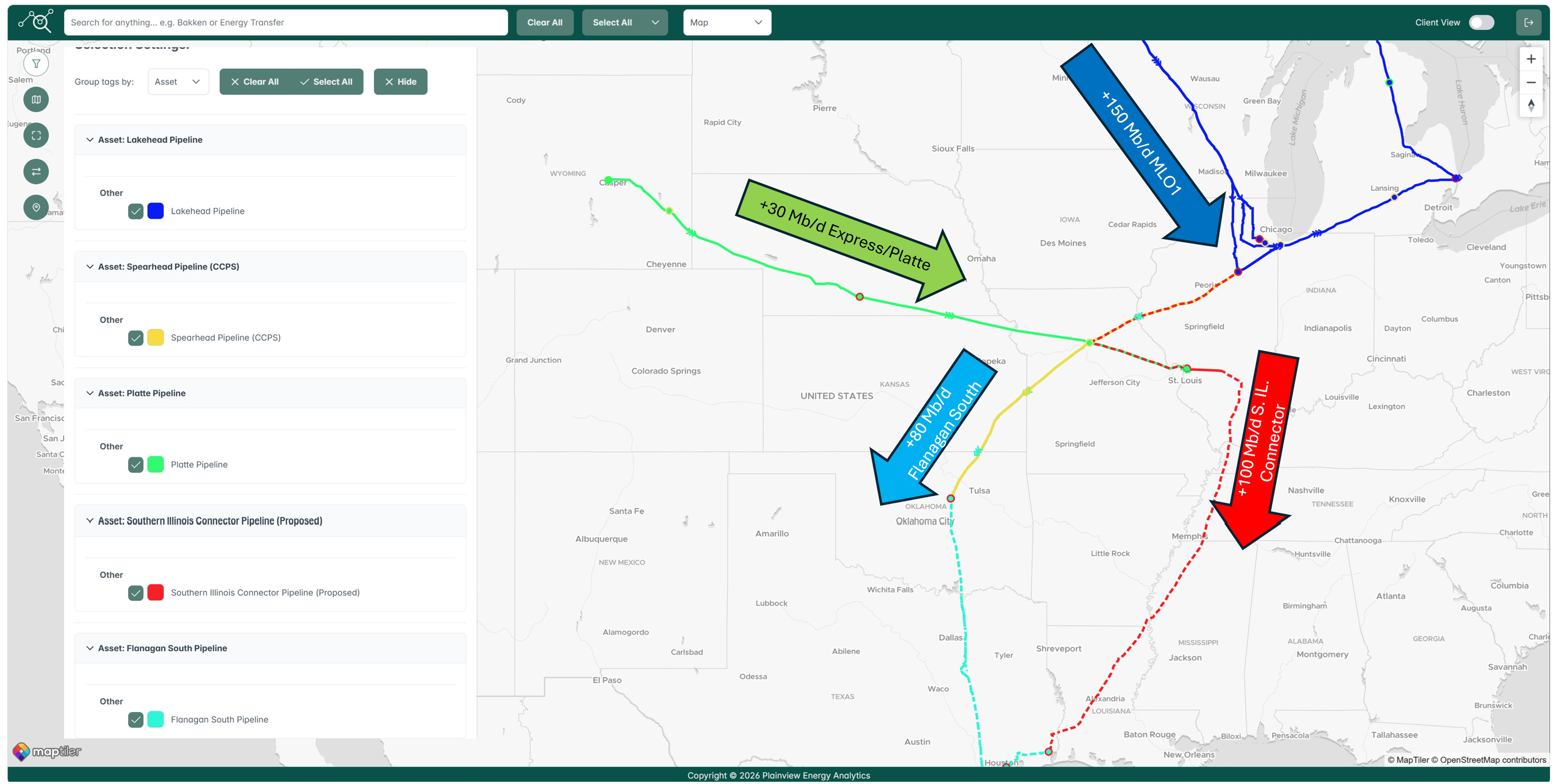
Recent disclosures in permit applications and quarterly earnings calls have provided clarity on exactly how Enbridge plans to route incremental volumes from its Mainline Optimization projects (MLO1 and MLO2) to market. Despite announcing a delay to the upstream portion of MLO2, Enbridge continues to actively prioritize its downstream segments, signaling continued confidence in the project. By analyzing these recent regulatory filings and corporate updates, we can begin to map out precisely how Enbridge’s multi-phase egress strategy plans to leverage existing infrastructure and strategic joint ventures to move growing Western Canadian production directly to key U.S. Midwest and Gulf Coast refining hubs.
To handle the 180,000 barrels per day (bpd) of incremental crude coming in under Mainline Optimization 1 (MLO1), Enbridge appears to be relying heavily on the Southern Illinois Connector project as a primary downstream solution. A 50-50 joint venture with Energy Transfer, this project has secured 100,000 bpd in commitments to route heavy barrels directly to the U.S. Gulf Coast. The initiative relies almost entirely on leased capacity across existing infrastructure, specifically Enbridge’s Spearhead Pipeline and the Platte system, paired with a short new-build connector between Wood River and Patoka, Illinois. From Patoka, barrels transfer to an additional lease on the Energy Transfer Crude Oil Pipeline (ETCOP) bound for Gulf Coast refineries in Nederland, Texas (dashed red line below), while the remaining ~80,000 bpd of MLO1 heavy crude will presumably head toward Cushing, Oklahoma, via an expanded Flanagan South Pipeline.
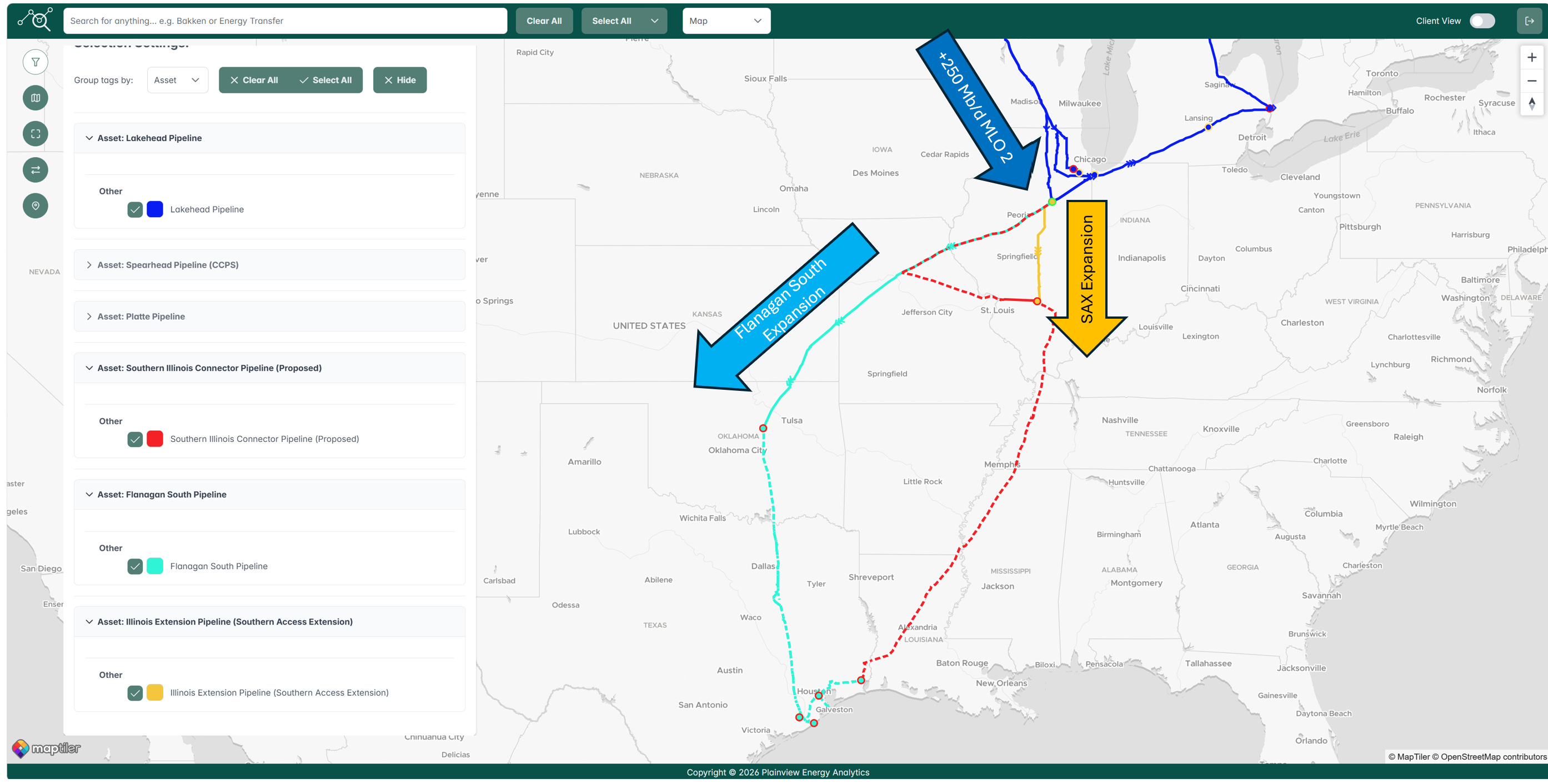
Looking ahead to Mainline Optimization 2 (MLO2), Enbridge has shifted focus by delaying the upstream component and prioritizing downstream infrastructure. Designed to unlock up to 250,000 bpd of additional Canadian crude egress, MLO2 involves complex flow rerouting. As we have outlined in previous videos, light crude will be redirected southward through pipeline reversals connecting to the Dakota Access Pipeline (DAPL) and the Chicap line. Downstream options for MLO2’s 250,000 bpd of incremental heavy crude appear to center on further expanding the Flanagan South system to the U.S. Gulf Coast and expanding the Southern Access Extension pipeline (see figure below). Expanding the Southern Access Extension creates an additional pathway into ETCOP or third-party assets such as the Capline system.