Enbridge’s North Dakota Pipeline (NDPL) has reportedly been shut since November 14 after organic chloride contamination was found in Bakken crude arriving at its Clearbrook, Minnesota terminal, according to an Argus report published today citing unnamed sources. Enbridge has not confirmed a shutdown or given a restart timeline. Energy Aspects said at least one Midwest refiner has declared force majeure, and a source told Reuters that refiner is Flint Hills Resources’ Pine Bend refinery in Minnesota. It isn’t yet clear where the contamination entered the system, or whether the shut-in covers every line or only the leg into Clearbrook.
Much of the coverage so far repeats a 475,000 barrels per day (bpd) system capacity figure, a number that significantly overstates the volumes actually at stake. NDPL isn’t a single pipe. It’s a network of gathering feeder lines and dual intrabasin trunklines with different sizes and routes. As the figure below shows, dual trunklines run from the Tioga/Beaver Lodge terminal to Berthold and have 342,000 to 430,000 bpd of capacity, depending on the segment. At Berthold, the flows split. Most of the crude, about 215,000 bpd, moves east on the single 16-inch NDPL mainline to Clearbrook, Minnesota (see flow graph below). A small volume, recently around 20,000 bpd, heads north to Enbridge’s Canadian Mainline. That northbound line can carry 145,000 bpd, but its flows haven’t topped 45,000 bpd since 2020.
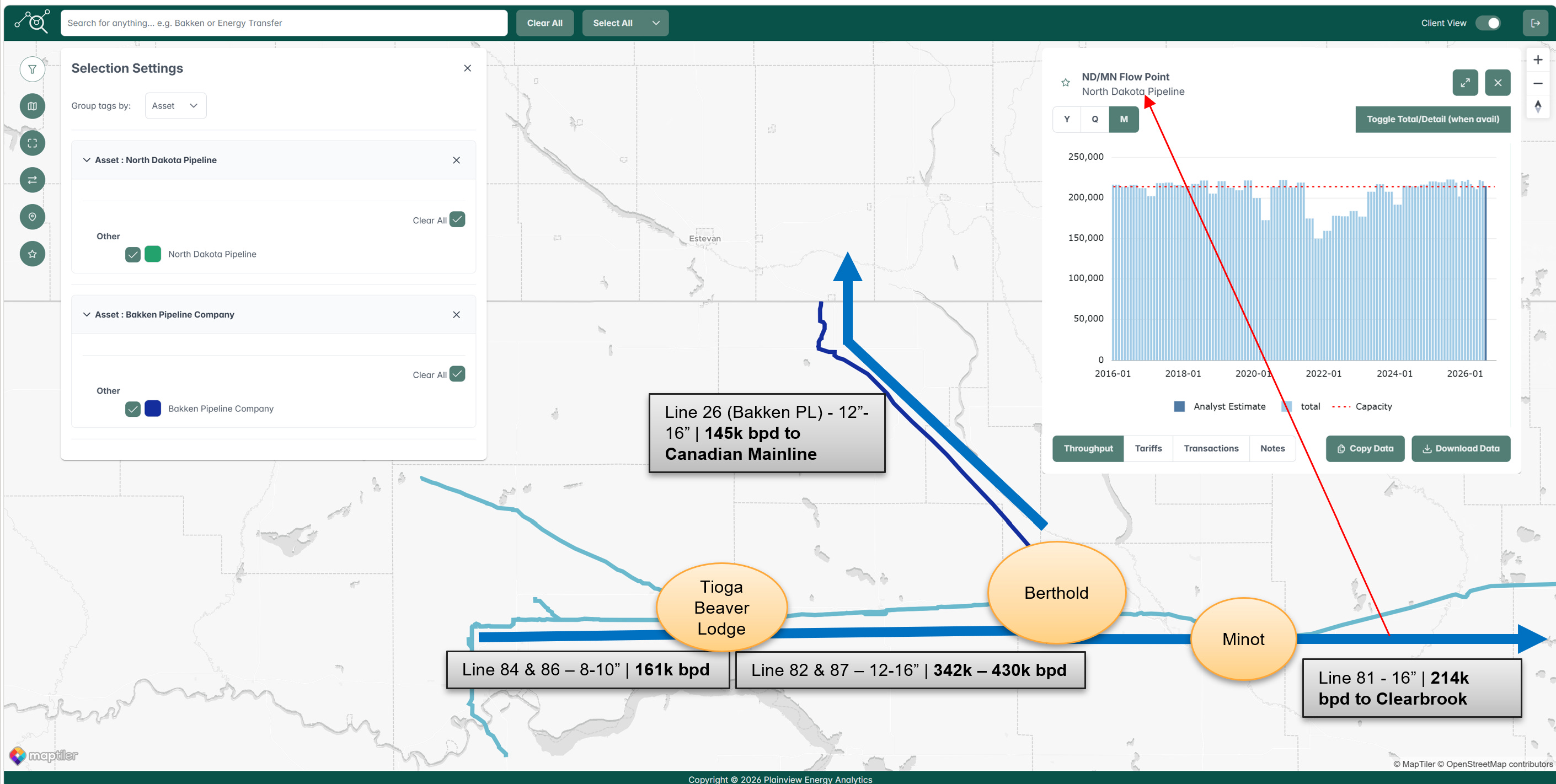
From April to July, the largest shippers into Clearbrook were Gunvor at about 40,000 bpd, Chord Energy (North Dakota’s largest oil producer) at about 36,000 bpd, and Tidal Energy Marketing (Enbridge’s marketing arm) at about 26,000 bpd. Gunvor was also the largest shipper on the northbound line over the same period, moving about 13,000 of roughly 21,000 bpd.
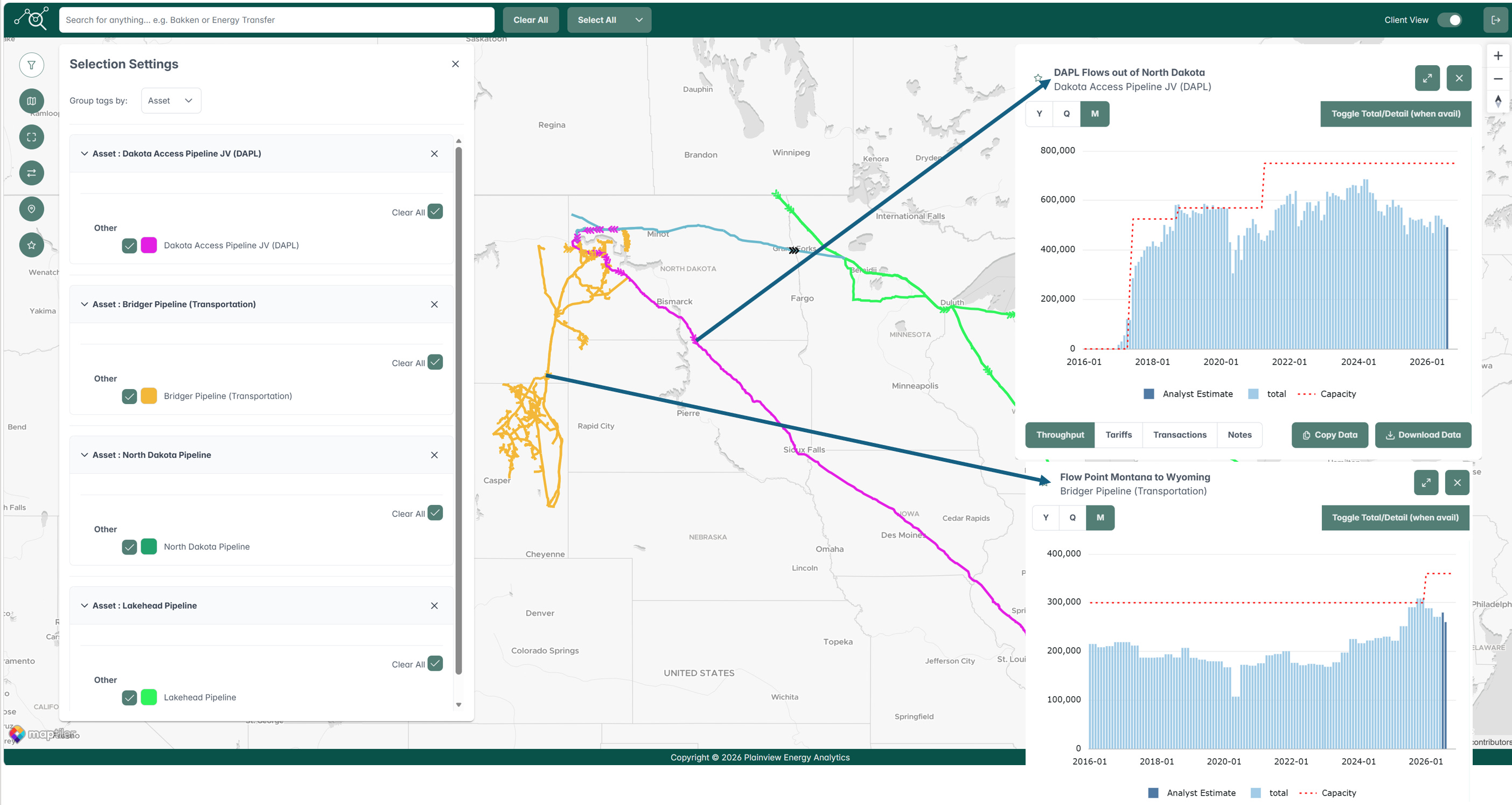
If the whole NDPL system is affected and stays down for a meaningful stretch, about 235,000 bpd of crude would need another outlet. Of the egress options, Dakota Access (DAPL - pink line in figure below), line from North Dakota to Patoka, Illinois, has significant supply connectivity and the most latent capacity. Flows on the pipeline averaged about 526,000 bpd from April to July, which leaves roughly 225,000 bpd of space (see flow graph below). Bridger (orange lines) could take some barrels too, with recent flows of around 270,000 bpd against an estimated 350,000 bpd of capacity (see flow graph below). Rail can help at the margin, but spot rail capacity is usually scarce, and most Bakken crude-by-rail is currently going to the West Coast (see Plainview’s recent piece on Washington’s growing appetite for Bakken crude by rail).
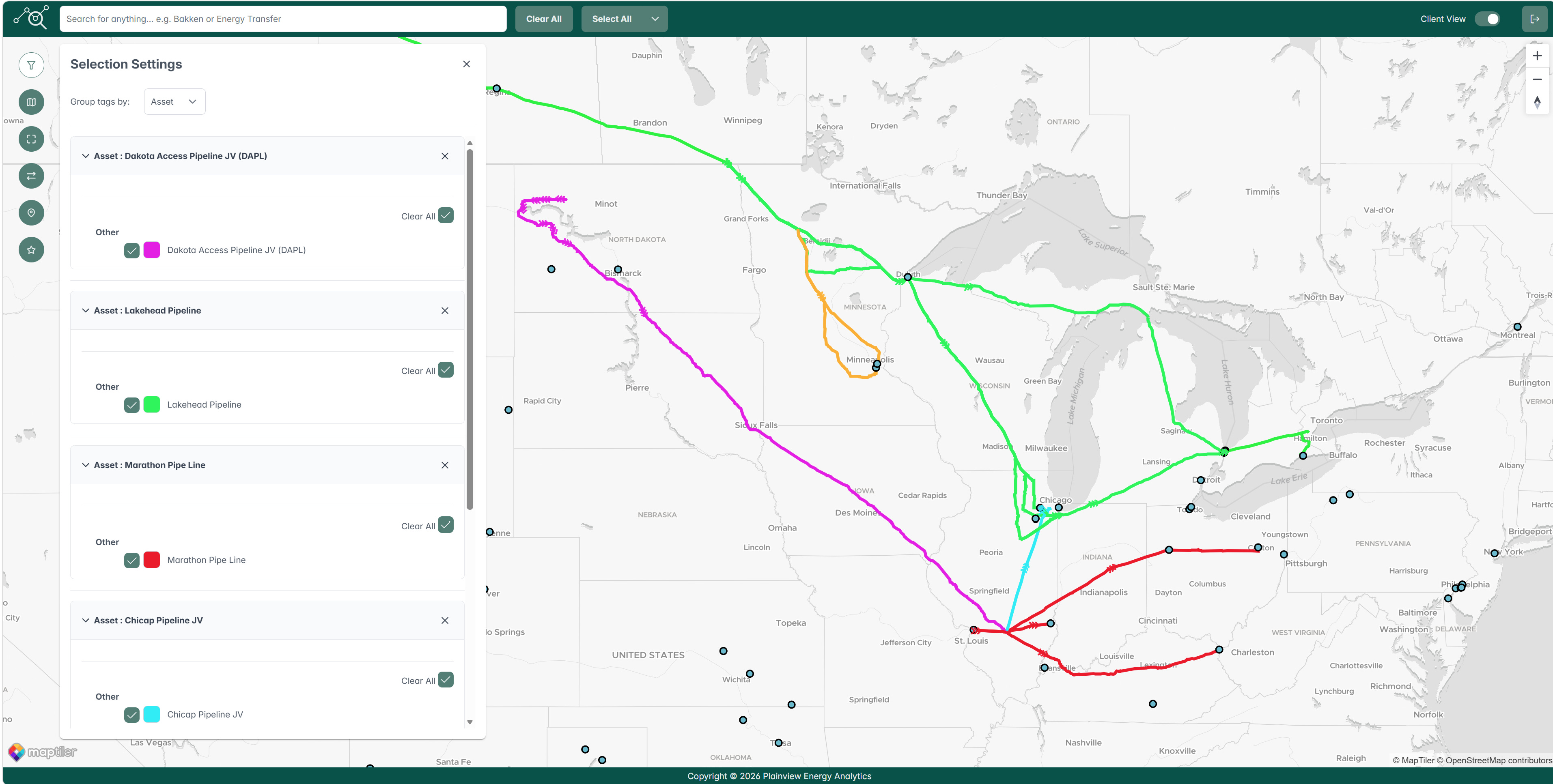
Refineries that have historically run NDPL’s light barrels likely include Flint Hills’ 335,000 bpd Pine Bend refinery and Marathon’s 105,000 bpd St. Paul Park refinery (pending its sale to CVR), both in Minnesota. NDPL barrels also likely move onto the Enbridge Mainline at Clearbrook (green lines in the figure below), which supplies various other Midwest refineries. Refiners replacing NDPL supply may lean harder on the Canadian light crude already arriving on the Mainline. Bakken barrels pushed onto DAPL (pink line) could also replace NDPL volumes serving the Midwest by landing at Patoka, Illinois, a hub with extensive pipeline links to Midwest and Chicago-area refiners, including Chicap (light blue line) and MPLX (red lines). DAPL’s direct link to the Bakken and its third-party connectivity downstream of Patoka will likely limit the downstream impact if the outage is prolonged.