The Vancouver Port Authority announced last week that it is moving forward with a crucial dredging project near the Second Narrows in Burrard Inlet, with work scheduled to begin this September. This marine infrastructure project is a vital development for the Canadian crude oil market, as it directly addresses a looming bottleneck for potential future expansions of the Trans Mountain pipeline system.
Solving the Current Draft Restrictions
Currently, Trans Mountain’s volumes are not restricted by pipeline or terminal capacity. Over the past year, the pipeline has consistently moved around 750,000 barrels per day (bpd), of which about 450,000 bpd exits through the Westridge Marine Terminal. The recent Iran conflict has pulled more volumes to Westridge with June 2026 loadings trending at a record pace of over 550,000 bpd based on Plainview’s ship tracking analysis (see image below). While this remains under Westridge’s current physical limit of 630,000 bpd, the terminal faces a strict regulatory cap of 34 Aframax vessel loadings per month.
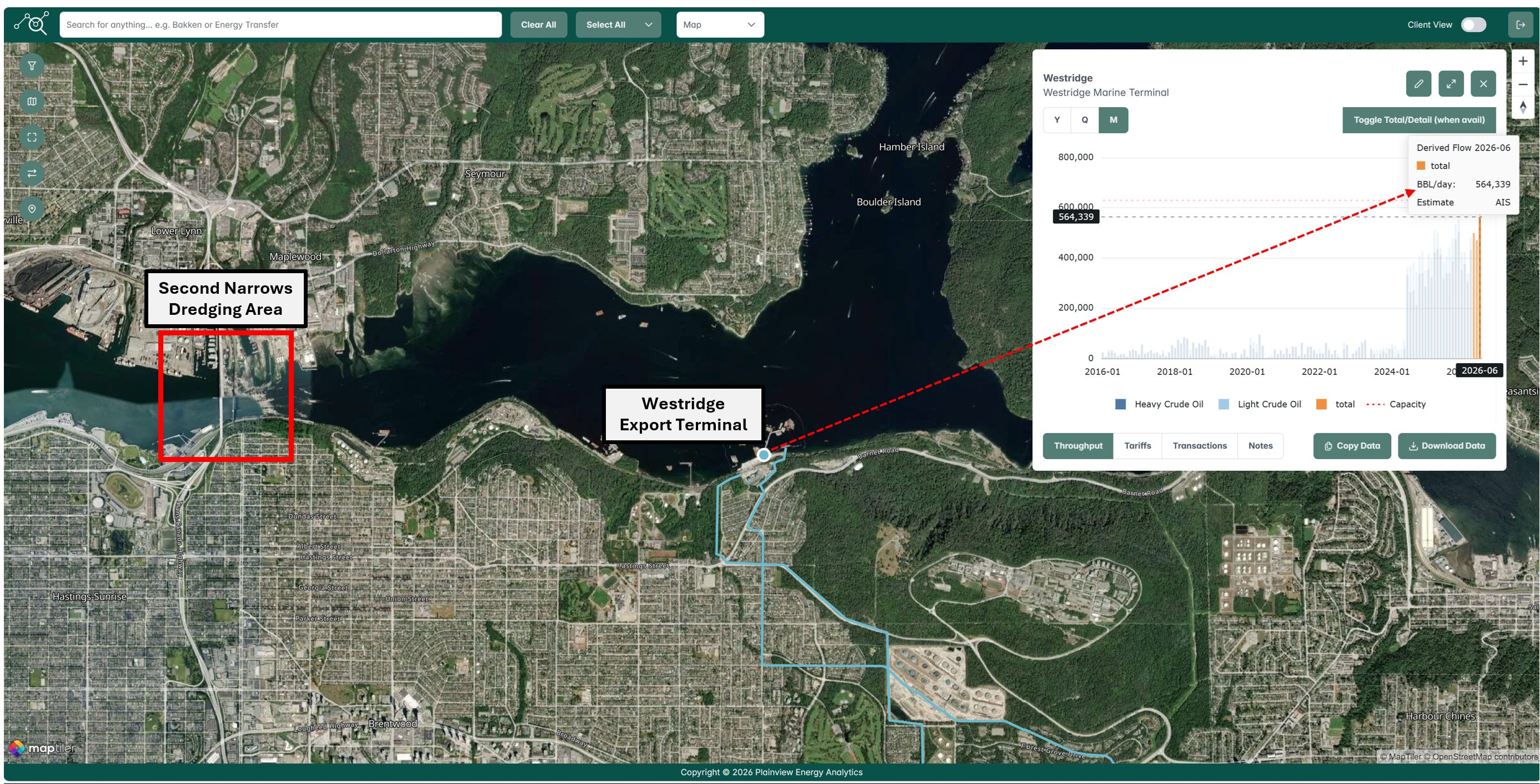
Because shallow water depths create strict draft restrictions, these Aframax vessels currently only load around 600,000 barrels of oil, representing roughly 75% of their full 800,000-barrel capacity. Deepening the channel may allow these 34 monthly ships to load to full capacity, effectively expanding the terminal’s throughput without increasing vessel traffic.
Phase 1: Aligning with the 2027 DRA Expansion
The timing of the dredging project aligns well with Trans Mountain’s upcoming Drag Reducing Agent (DRA) expansion. Scheduled to come online in January 2027, the DRA initiative will boost the pipeline’s current nameplate capacity by 10%, adding roughly 90,000 bpd to bring total system capacity to 980,000 bpd.
Currently, Trans Mountain utilizes three delivery points that sum to a combined delivery capacity of 925,000 bpd (see image below):
Westridge Marine Terminal: 630,000 bpd
Puget Sound Pipeline (U.S.): 240,000 bpd
Burnaby Refinery: 55,000 bpd
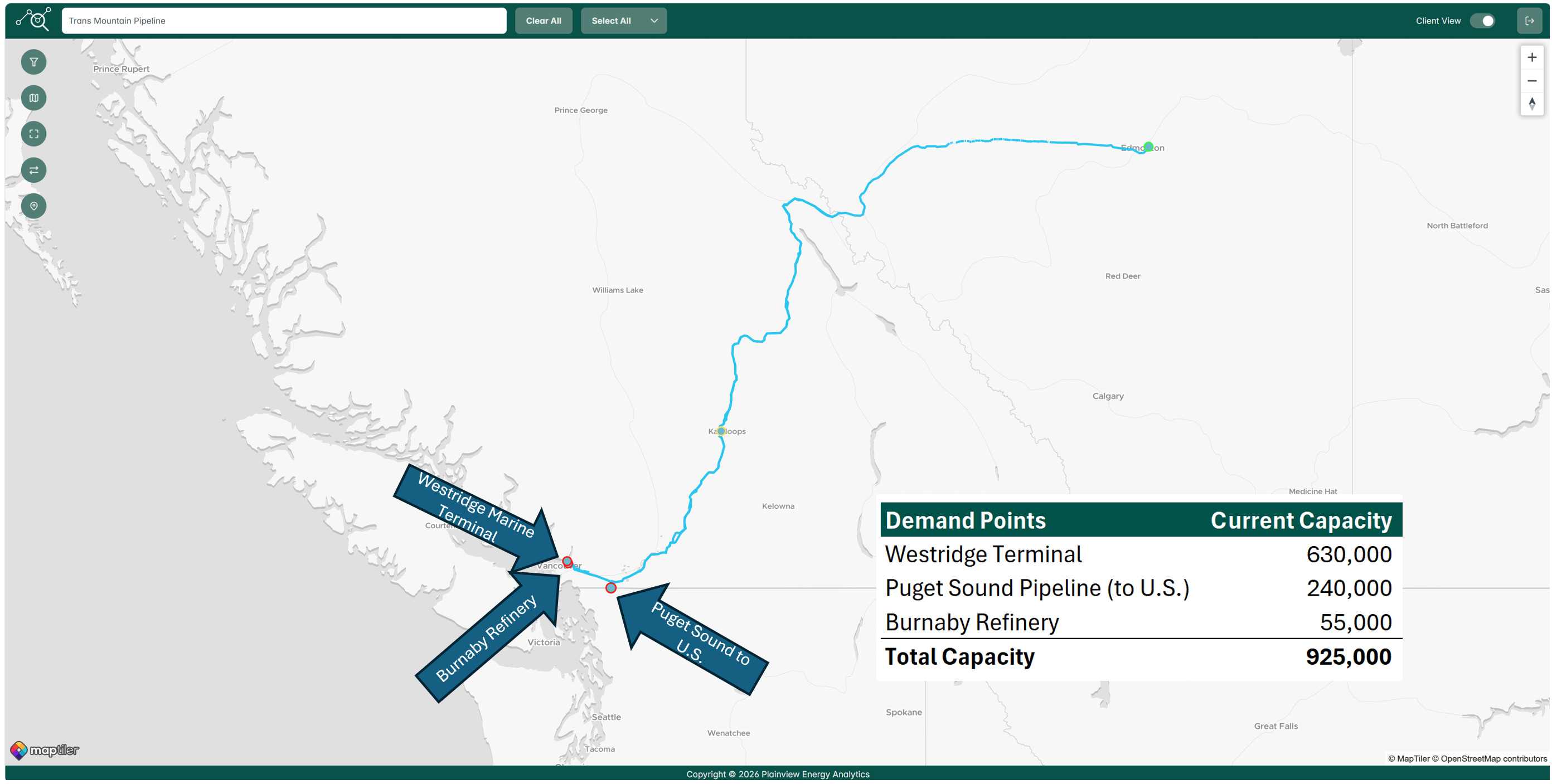
Because existing delivery options barely exceed the current 890,000 bpd pipeline capacity, Trans Mountain will rely heavily on the newly dredged port to efficiently clear the additional 2027 DRA volumes without causing a bottleneck at the dock.
Phase 2: The Foundation for 1.19 Million bpd
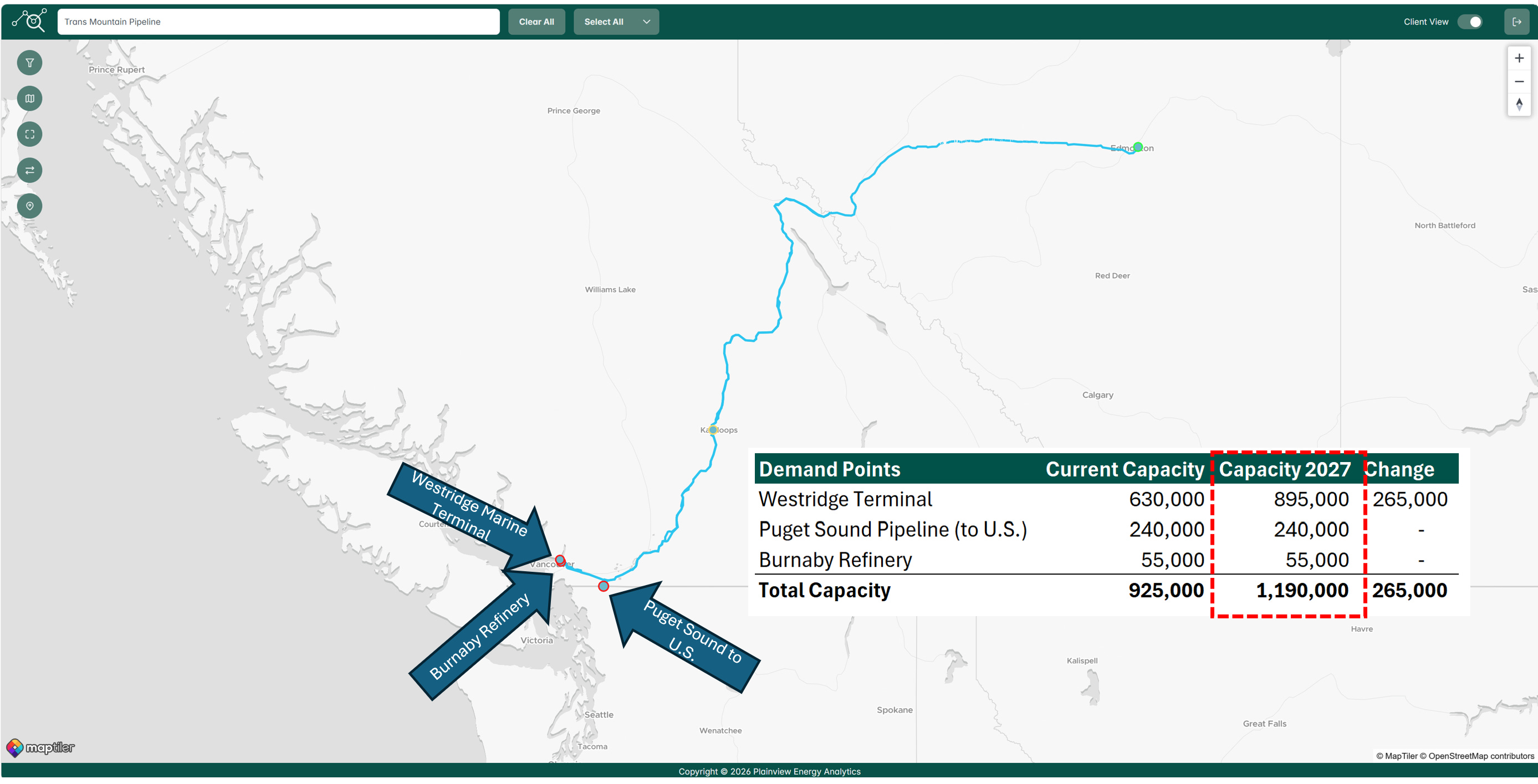
Looking toward the end of the decade, the port upgrade serves as the foundation for an even larger vision. Trans Mountain is contemplating a larger-scale pump station and mainline optimization project that could supercharge pipeline capacity up to 1.19 million bpd by 2028–2029.
To handle that future volume, any material expansion beyond the current configuration will require Westridge to handle a peak export capacity of 895,000 bpd (see image below). Assuming the regulatory cap remains at 34 tankers per month, those ships must be fully loaded at 800,000 barrels each to achieve this target. Combined with steady regional demand from the Puget Sound pipeline (240,000 bpd) and the Burnaby refinery (55,000 bpd), a deeper Burrard Inlet is the final, critical link required to fully maximize the delivery side of the Trans Mountain system.
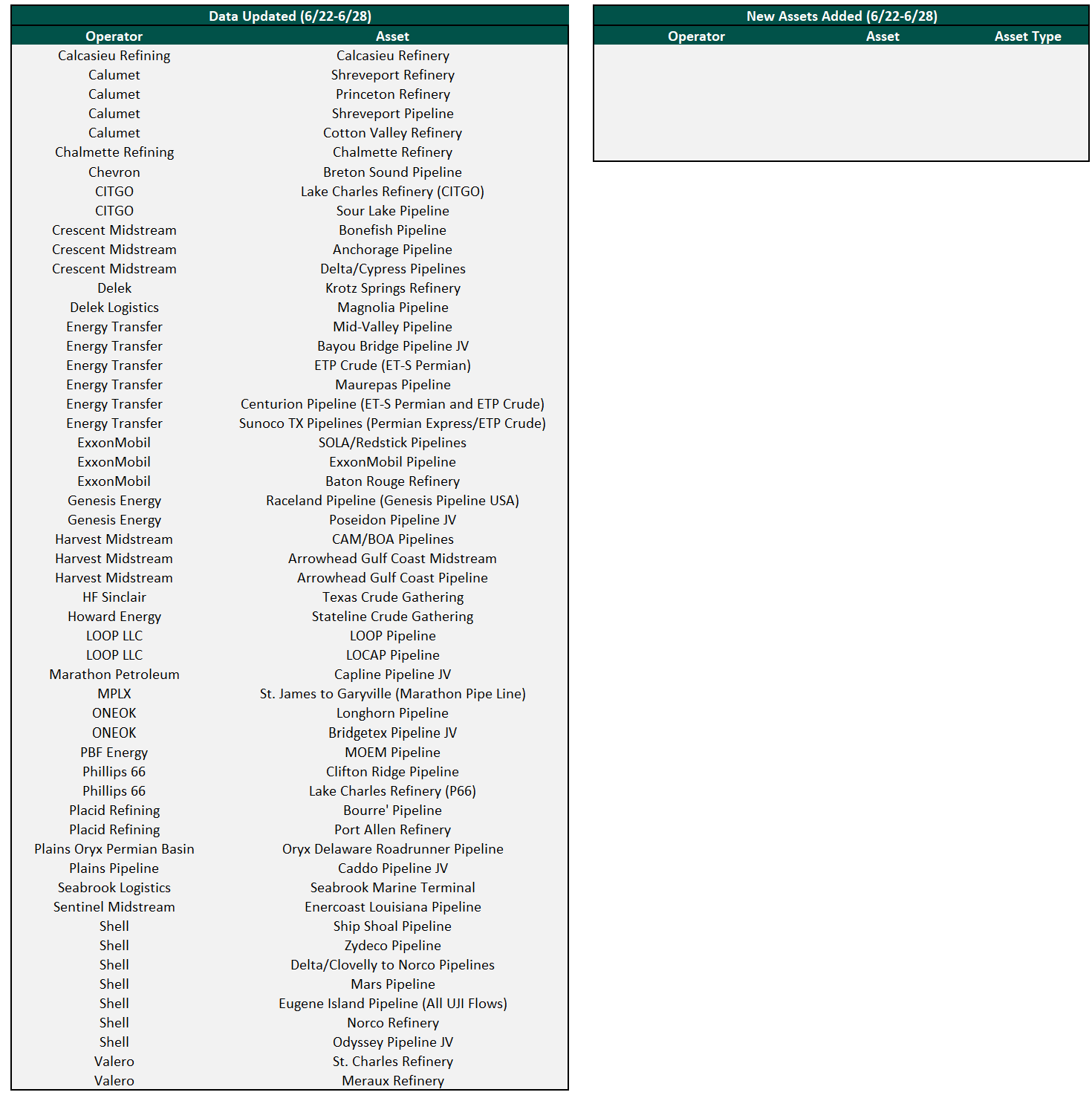
Flow/Transaction Updates and New Assets Under Coverage
Plainview has over 400 assets with crude oil throughput or transactional data on our platform and continues to add more each week. Data for existing assets under coverage are posted as soon as they become available. Below are the assets that were updated this week or newly added to coverage.