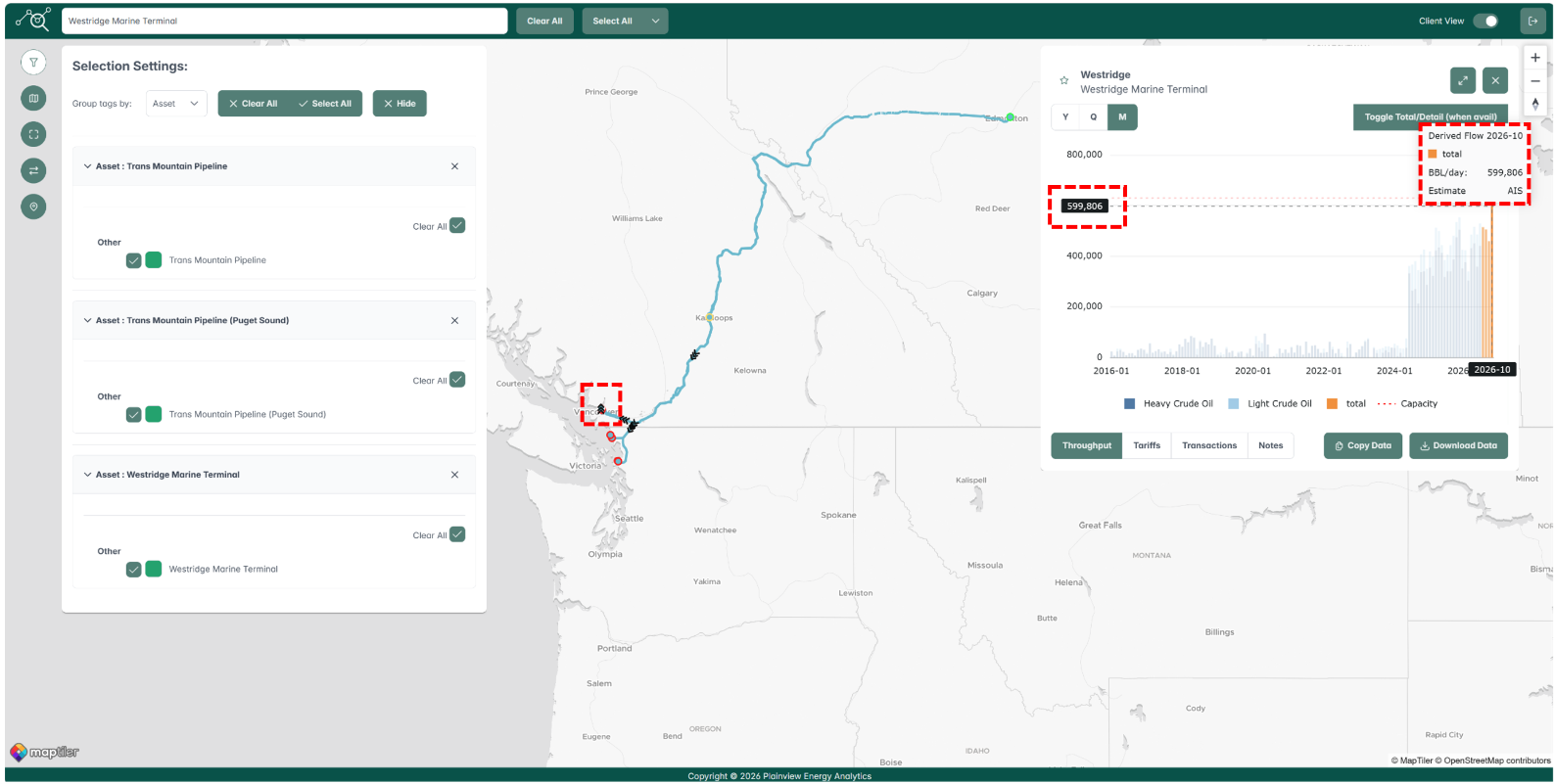
Shipments through Trans Mountain’s Westridge Marine Terminal appear to have climbed sharply in October, pointing to a meaningful step up in throughput on the pipeline. Plainview ship tracking estimates that dock volumes have averaged roughly 600,000 barrels per day so far this month, about 50,000 barrels per day higher than any previous month on record (see figure below). Those marine volumes imply that flows on the Trans Mountain mainline are running near 900,000 barrels per day (bpd), which puts the system slightly above its 890,000 bpd nameplate capacity.
The timing of the increase roughly lines up with Trans Mountain’s drag reducing agent (DRA) expansion project, which is designed to add 90,000 barrels per day of new capacity (bringing the total to 980,000 bpd). Regulatory documents and past public comments from the company have pointed to an estimated in-service date of December 2026. However, filings also laid out a construction schedule showing work could be complete by the end of September (see schedule below). Adding to the case for an early start, the Canada Energy Regulator (CER) approved Trans Mountain’s firm service contracting application for the project at the end of September, which theoretically could allow those new contracts to begin this month.

Trans Mountain previously announced that the mainline would be in apportionment for October 2026, meaning shipper nominations exceeded available space and the pipeline would be running relatively full. Apportionment on its own does not explain the record volumes, though. The pipeline has been apportioned in prior months without dock volumes reaching anywhere near current levels. The combination of record throughput, a completed construction window, and fresh regulatory approval for new contracts suggests the DRA expansion capacity may now be in service.
Volumes on the system may move higher again in January 2027. No additional physical capacity is scheduled for that period beyond the DRA project, but Trans Mountain received approval at the end of September to raise its committed capacity cap from 80% to 90% (see table below). That change shifts a larger share of the pipeline’s space into firm, contracted service, which could support higher and more consistent utilization going forward.

Looking further out, the next major milestone is the Mainline Optimization Project, currently slated for late 2028. That expansion would add roughly 210,000 barrels per day of capacity to the system, including around 200,000 barrels per day of new incremental firm capacity (see table above). Taken together, the DRA expansion, the higher committed capacity cap, and the optimization project mark a steady build-out of Canada’s only direct crude export route to the West Coast, and October’s record shipments may be the first visible sign of that next phase.
Flow/Transaction Updates and New Assets Under Coverage
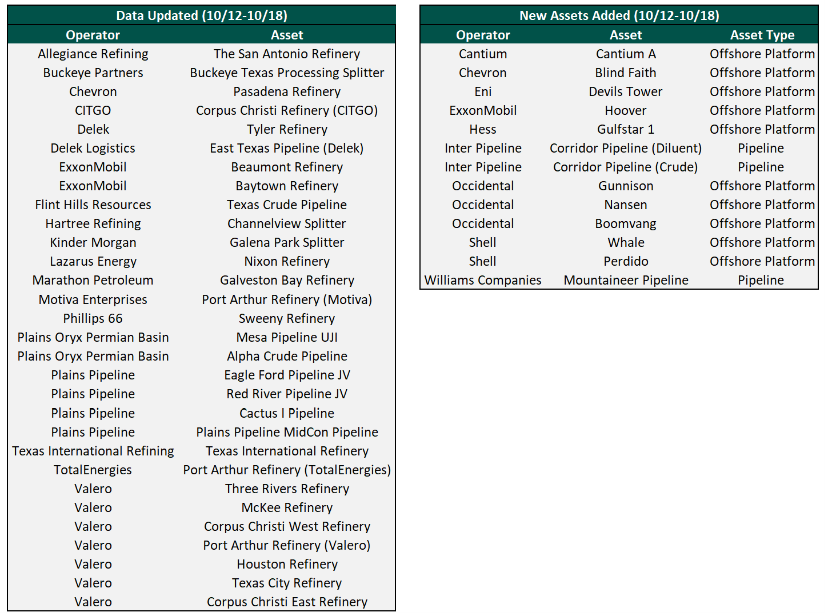
Plainview has over 500 assets with crude oil throughput or transactional data on our platform and continues to add more each week. Data for existing assets under coverage are posted as soon as they become available. Below are the assets that were updated this week or newly added to coverage.