

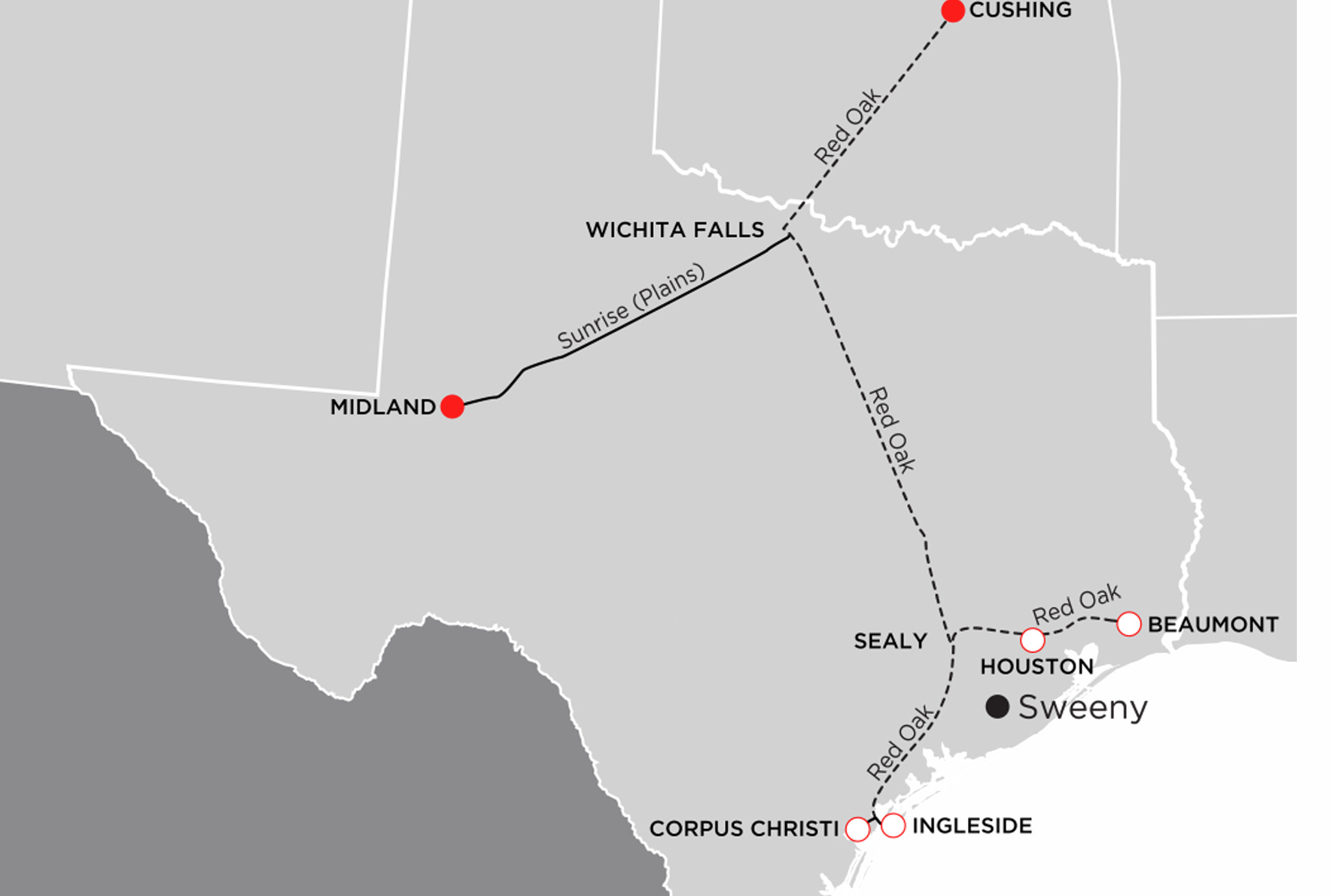
The Port of Corpus Christi, the largest crude oil export hub in the U.S. and home to almost a million barrels per day of refining capacity, noted in an interview last week that companies are exploring a new pipeline to connect Corpus Christi with Cushing, Oklahoma. The port currently lacks a direct or even indirect pipeline connection to Cushing, relying almost exclusively on production from the Permian and Eagle Ford basins. A dedicated pipeline from Cushing would significantly diversify the area’s supply slate, granting access to Canadian, Bakken, and other Midcontinent crude grades. This initiative somewhat echoes the ill-fated Red Oak pipeline (see image below), a joint venture between Phillips 66 and Plains All American, which was canceled in 2021 due to COVID-19.
Incremental Supply Headed Toward Cushing
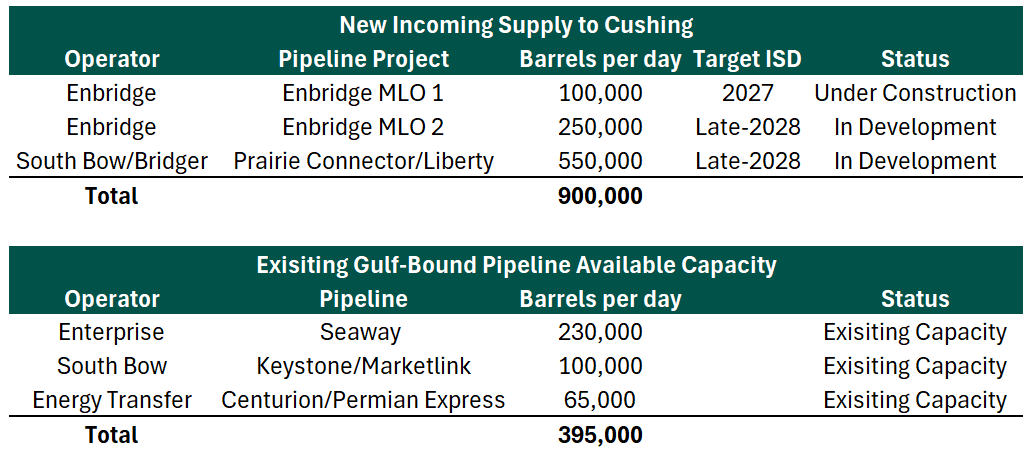
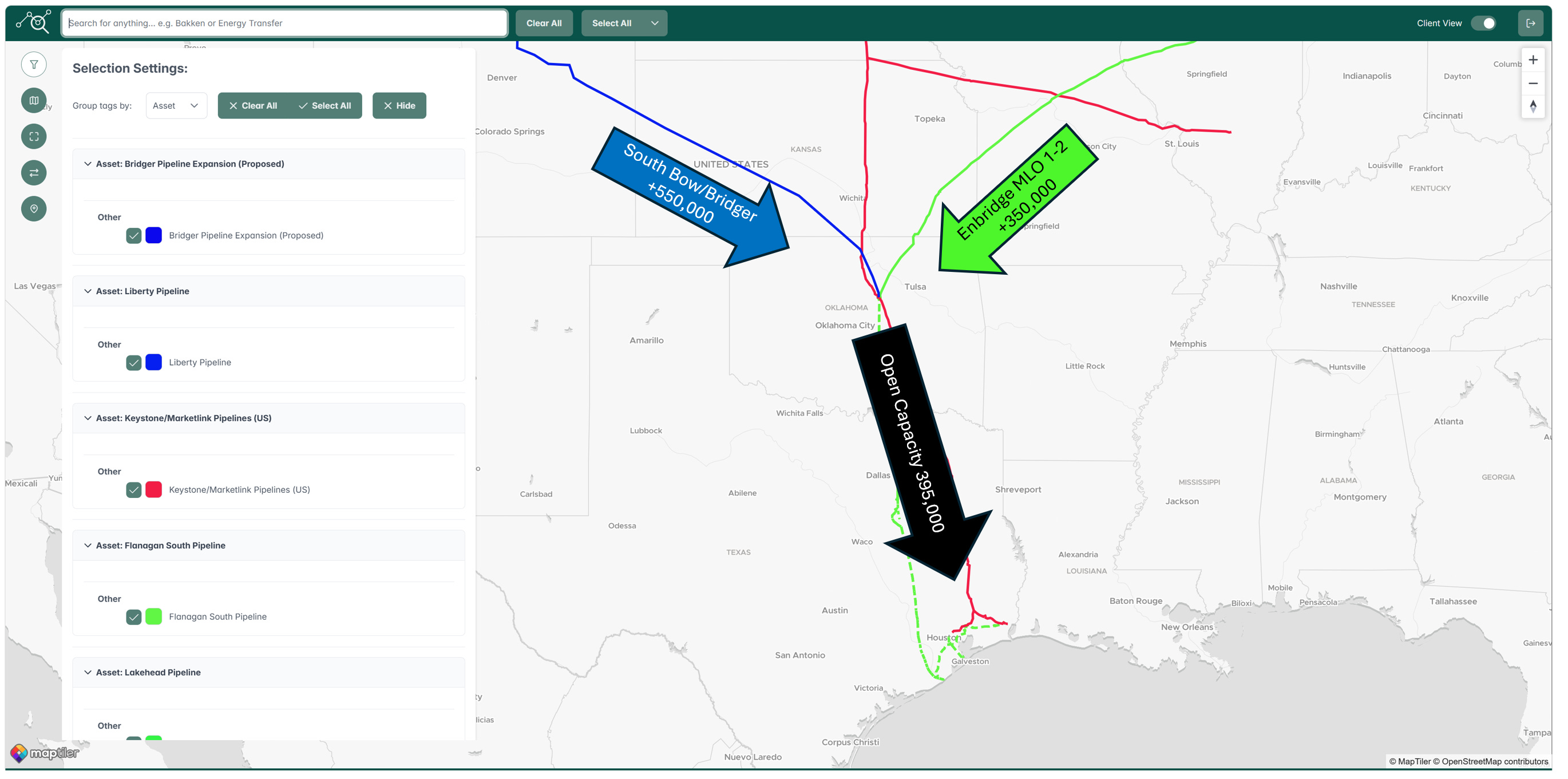
The likely primary driver for this renewed interest is a perceived supply-demand mismatch at Cushing over the coming years. Various midstream projects, most notably Enbridge’s Mainline Optimization phases and the new pipeline planned by South Bow and Bridger, could introduce up to 900,000 barrels per day (bpd) of new Canadian supply capacity into Cushing by late 2028. When measured against the current available egress capacity from Cushing to the Gulf Coast, estimated at roughly 400,000 bpd (based on 2025 average throughputs), a significant capacity constraint appears possible, theoretically justifying the construction of a new greenfield pipeline to move these barrels south (see figures and tables below).
Potential Brownfield Pipeline Expansions
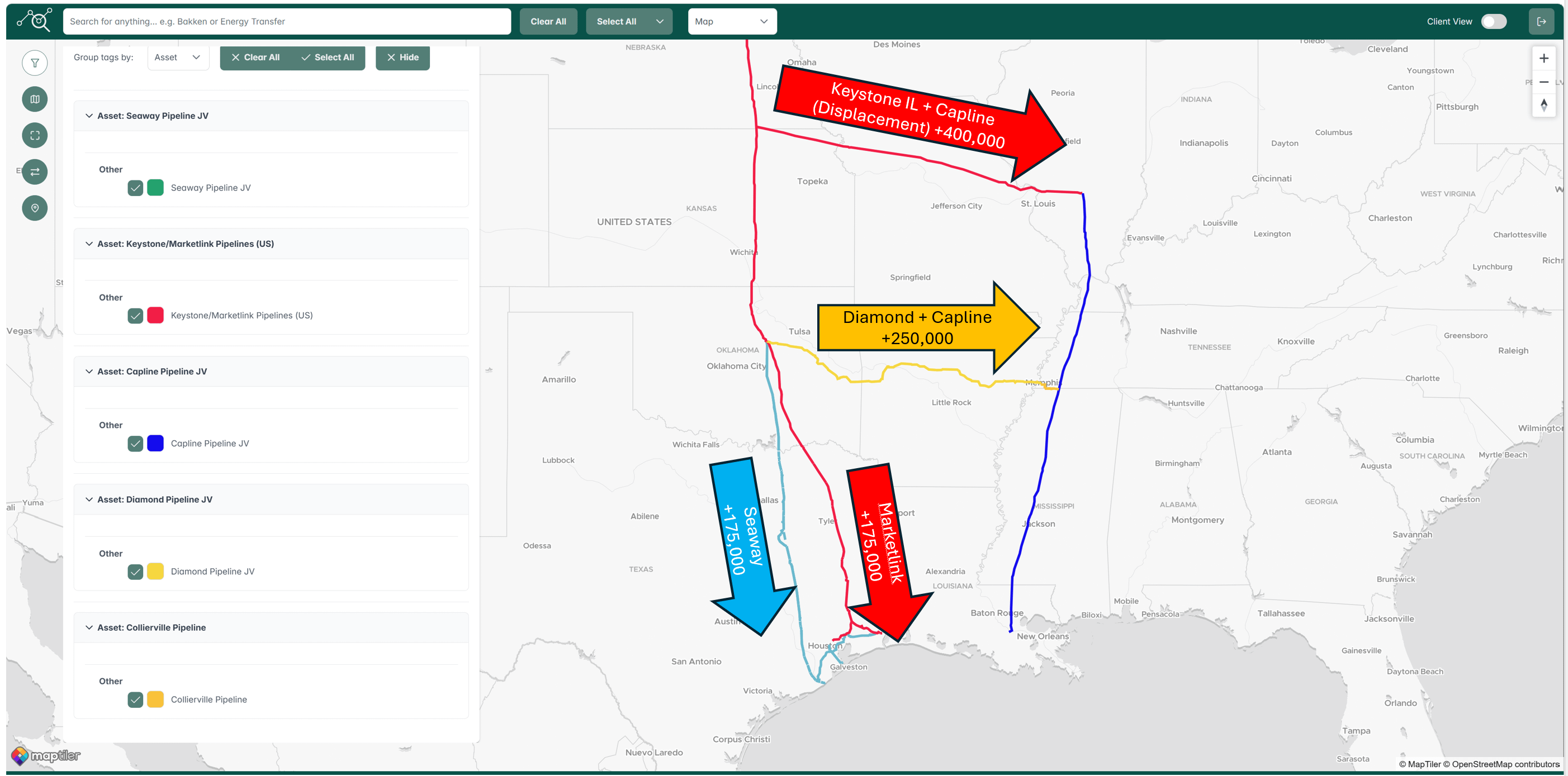
However, a closer examination suggests that a brand-new pipeline may be unnecessary. The industry possesses several brownfield alternatives, or expansions on existing infrastructure, that would likely prove more cost-effective than building a new corridor from scratch. We estimate operators could potentially unlock ~1,000,000 bpd of incremental capacity by utilizing the Seaway, Marketlink, Capline, and Diamond pipelines. These projects (outlined and illustrated in detail below), would rely on drag-reducing agents (DRAs) and additional pump stations, and likely offer a more capital-efficient path to market than new construction.

Seaway Expansion: Made up of two 30-inch pipelines, the legacy 30-inch Seaway I pipeline currently operates at only 350,000 bpd, well below the typical capacity for a pipe of this diameter. While the legacy pipeline’s age may impose constraints, we estimate an additional 175,000 bpd of capacity could be realized across the twin-pipeline system.
Marketlink Expansion: Regulatory filings indicate the pipeline has the potential to expand to nearly 1,000,000 bpd, which would add approximately 175,000 bpd to current capacity.
Keystone Displacement to Illinois + Capline Expansion: We estimate up to 400,000 bpd of legacy volumes on the Keystone system could be shifted toward Illinois to utilize expanded southbound capacity on the Capline pipeline.
Diamond/Capline Expansion: An expansion of the Diamond pipeline with a direct connection into Capline could add another 250,000 bpd of capacity to the Gulf Coast.
Despite typically being more cost-effective, there may be hurdles for some of these brownfield expansions. Contractual obligations, such as “most favored nations” clauses on pipelines like Diamond and Capline, may limit the ability of operators to offer the competitive tariffs required to attract shippers. Ultimately, while Port of Corpus Christi views a direct Cushing connection as a strategic proactive measure, we believe a new greenfield pipeline has longer odds compared to incremental system expansions on existing infrastructure.
Flow/Transaction Updates and New Assets Under Coverage
Plainview has over 400 assets with crude oil throughput or transactional data on our platform and continues to add more each week. Data for existing assets under coverage are posted as soon as they become available. Below are the assets that were updated this week or newly added to coverage.
