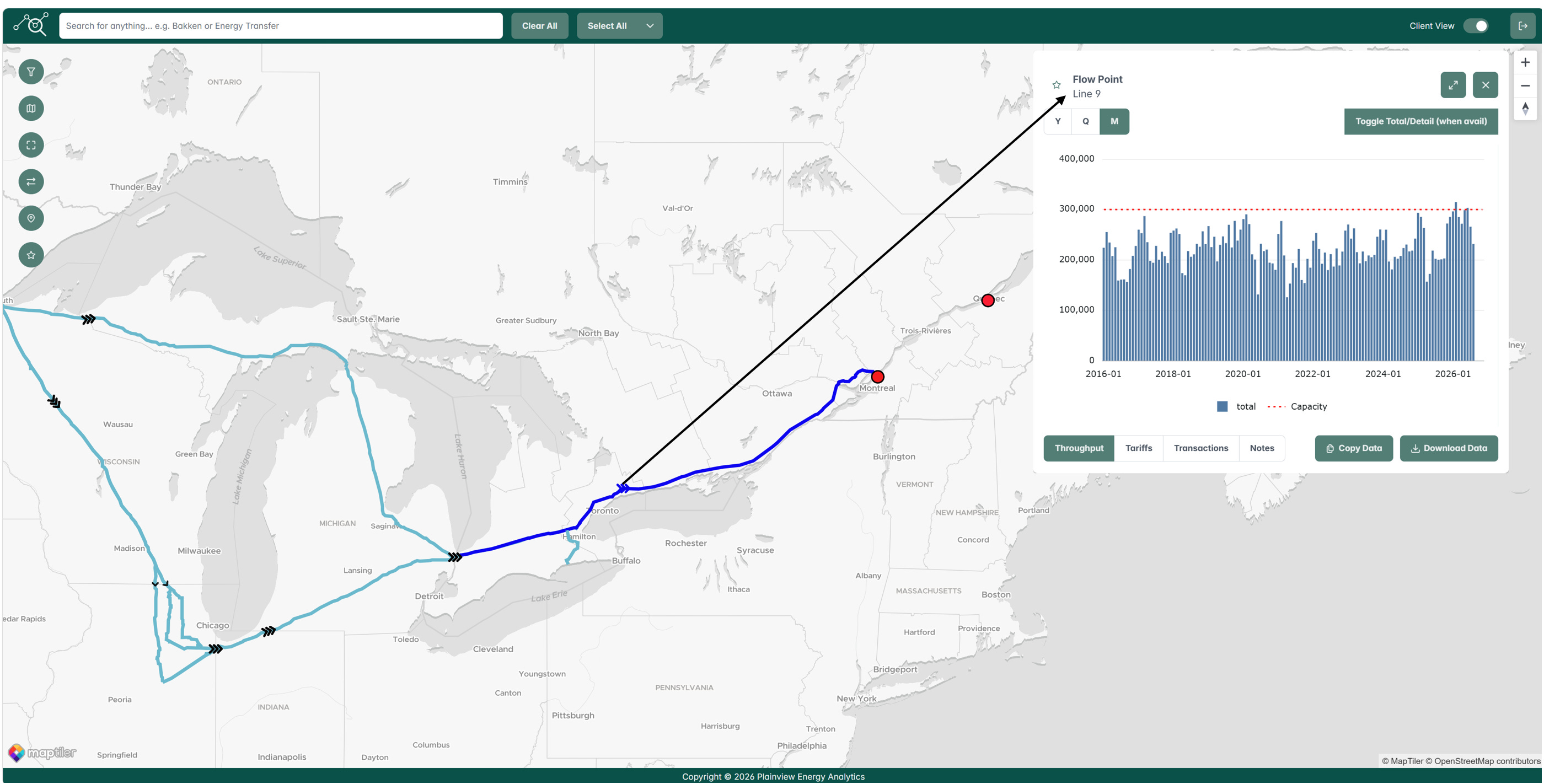
Enbridge announced lower earnings on its oil pipelines in 3Q 2026 after cutting shipping fees on Line 9, a major pipeline running from Sarnia, Ontario, to Montréal. After the pipeline's original 10-year contracts expired in late 2025, Québec’s only two oil refiners, Suncor and Valero, signed new five-year deals in July 2026 that regulators approved in September. To lock in those agreements, Enbridge lowered its base shipping rates by 15% to 25%, though the refiners' actual savings are likely smaller since some extra costs are now billed separately. While StatCan data shows Line 9 ran at record volumes through 1H 2026 (see throughput graph below), lower committed capacity under the new contracts could weigh on future flows.
Enbridge did not disclose how much capacity each refiner committed, though the new tariff terms offer clear clues. Under the new framework, Enbridge keeps all revenue on the first 208,000 bpd shipped, a threshold that likely reflects the combined commitment and marks a roughly 25% drop from the previous 275,000 bpd. Above that 208,000 bpd mark, any shipper that committed at least 130,000 bpd receives a share of the additional revenue. Because the pipeline has limited capacity for both refiners above that tier, one likely committed roughly 130,000 bpd while the other ~78,000 bpd, just meeting the threshold for the discounted committed rate. (These figures are our estimates based on the regulatory filing rather than disclosed numbers.)
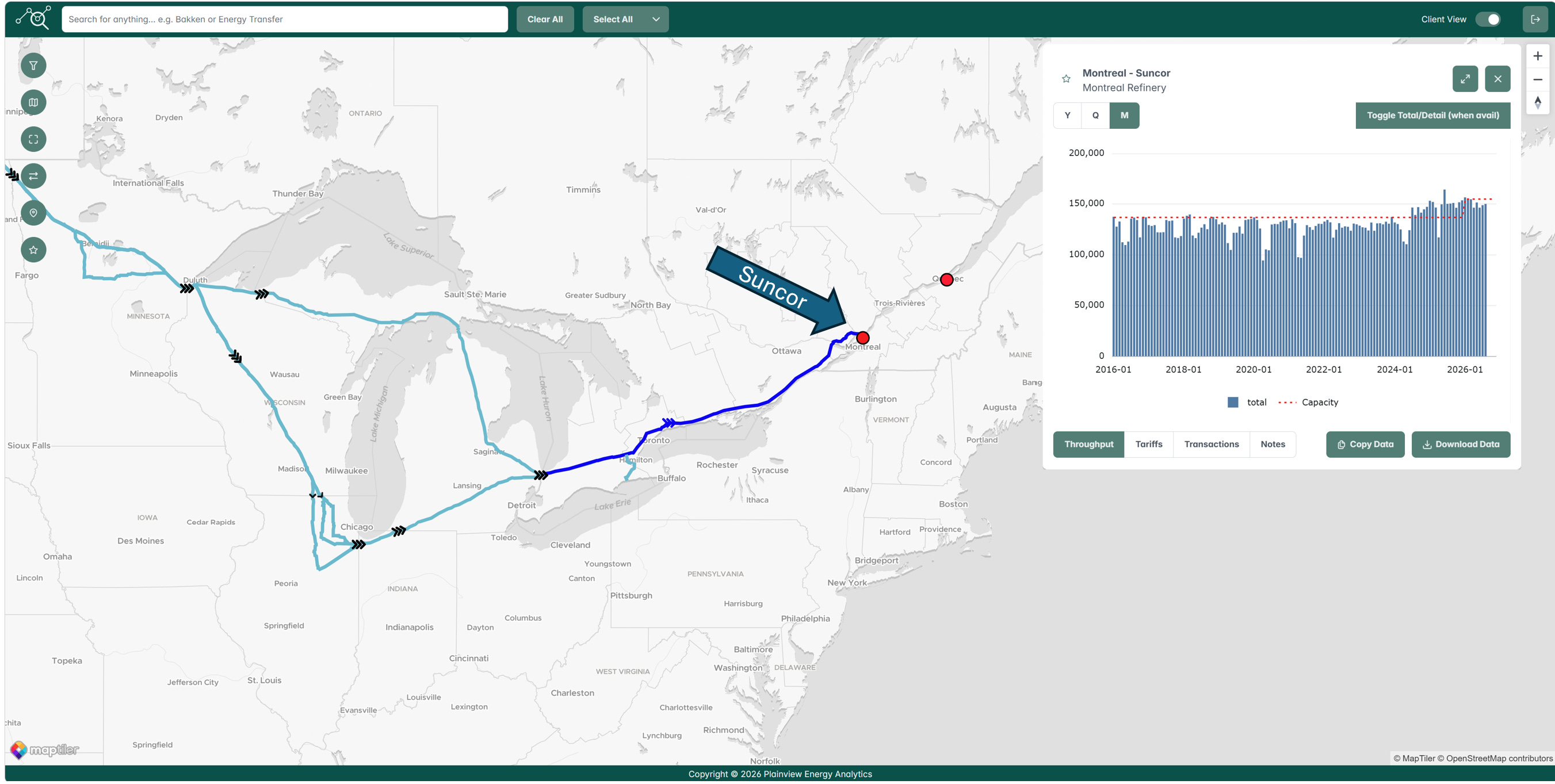
Suncor's direct connection to Line 9 and growing crude needs at Montreal suggest it may be the larger shipper. Its refinery (red dot near Montreal in figure below) sits at the end of Line 9 (dark blue line), and Suncor re-rated its nameplate capacity in 2026 to about 157,000 bpd from 137,000. Plainview's modeling shows the refinery running above its old nameplate since mid-2024, often at 150,000 bpd or more (see throughput graph below).
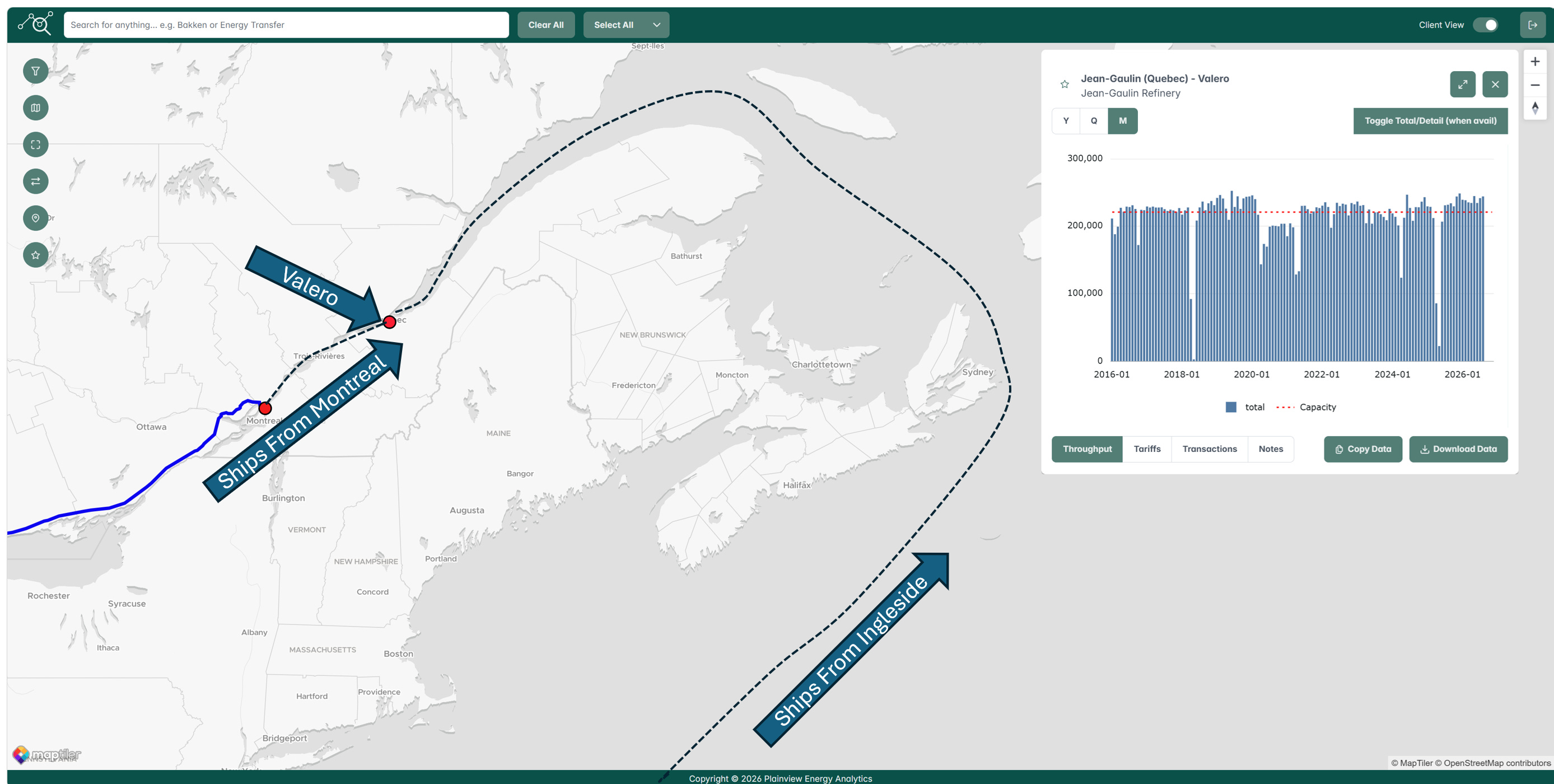
Valero's Jean-Gaulin refinery in Lévis is larger (see our modeled throughput in graph below) but sits about 250 km downriver from where Line 9 ends. Valero has to reship its Line 9 barrels by tanker from its Montréal East terminal. Our vessel tracking shows the Montréal–Lévis shuttle dropped from two ships to one starting in August 2026, weeks after the new contracts were signed. The reduced barrels from the Montreal shuttle were largely replaced by tankers coming from Ingleside, Texas. In other words, Valero appears to have recently swapped some Line 9 barrels for seaborne U.S. Gulf Coast crude, consistent with a potential smaller pipeline commitment.
For Enbridge, the lower tolls and fewer committed barrels are a modest headwind. Some of that revenue can come back if the refiners ship above their commitments at listed incentive rates. If commitments total about 208,000 bpd, roughly 90,000 bpd of the line is not underpinned by base commitments. That spare room could give Enbridge’s marketing arm or other traders an opening to move barrels to Montréal for export, possibly using spare dock and tank capacity at Valero’s Montréal East terminal if its shuttle needs have shrunk. Exports via this route would likely be competitive with spot Canadian crude export options along the U.S. Gulf Coast.
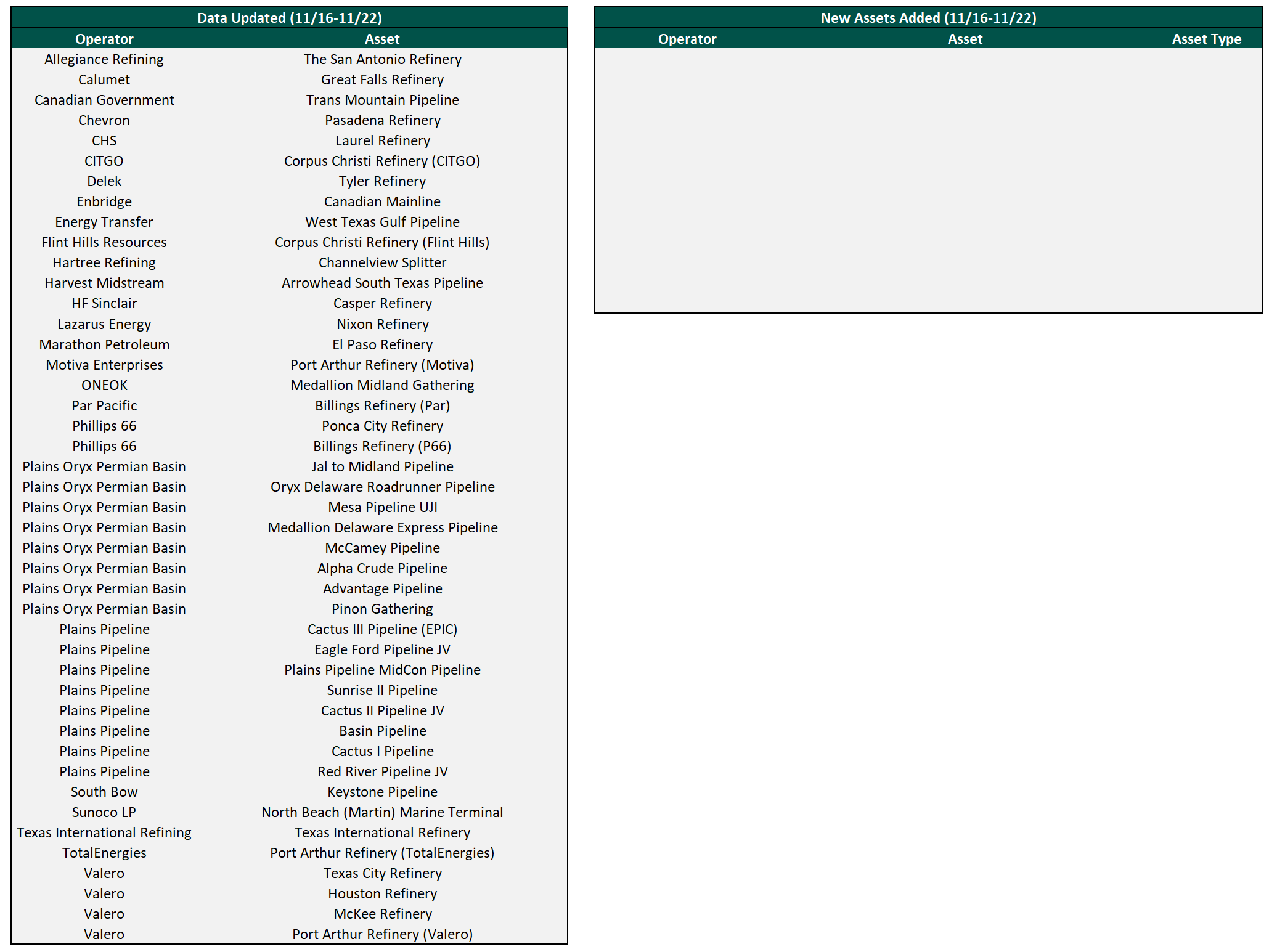
Flow/Transaction Updates and New Assets Under Coverage
Plainview has over 500 assets with crude oil throughput or transactional data on our platform and continues to add more each week. Data for existing assets under coverage are posted as soon as they become available. Below are the assets that were updated this week or newly added to coverage.